
Energy-Efficient Home Certification in Texas
What It Means, Why It Matters, and How to Choose the Right One in the Rio Grande Valley
If you’re buying or building a new home in Texas, you’ve probably seen terms like ENERGY STAR®, DOE Efficient New Homes, HERS score, or certified energy-efficient home.
They sound official — but what do they actually mean?
More importantly, which certifications truly matter in the Rio Grande Valley, where heat, humidity, and long cooling seasons dominate energy use?
This guide explains energy-efficient home certification in Texas in plain language, how certification differs from standard construction, and how to choose a program that delivers real comfort and long-term savings in South Texas.
What Is an Energy-Efficient Home Certification?
An energy-efficient home certification is a third-party verification process that confirms a home meets specific performance standards — not just building code.
Unlike marketing claims, certification requires:
- Inspections during construction
- Performance testing after completion
- Documented results
In short, certification answers one critical question:
Does the home actually perform better — or is it just advertised that way?
Why Certification Matters More in South Texas
Texas building codes establish minimum requirements, not optimal performance. In the Rio Grande Valley, minimum code often falls short.
RGV homes face:
- Long, intense cooling seasons
- High humidity
- Heavy air-conditioning use
- Rising electricity costs
Without certification, many homes:
- Leak air
- Struggle with humidity
- Rely on oversized HVAC systems
- Cost more to operate long-term
Certification ensures the home is designed and tested to handle these realities — not just pass inspection.
Certified Homes vs Code-Built Homes (Key Difference)
A code-built home:
- Meets minimum legal requirements
- May not be tested
- Relies heavily on visual inspections
A certified energy-efficient home:
- Is inspected during construction
- Undergoes blower door and duct testing
- Must meet measurable performance targets
- Provides documentation to the buyer
This difference matters long after move-in day.
The Main Energy-Efficient Home Certifications in Texas
Several certification programs are available in Texas. While they share common goals, they are not interchangeable — especially in South Texas.
Below is a clear breakdown.
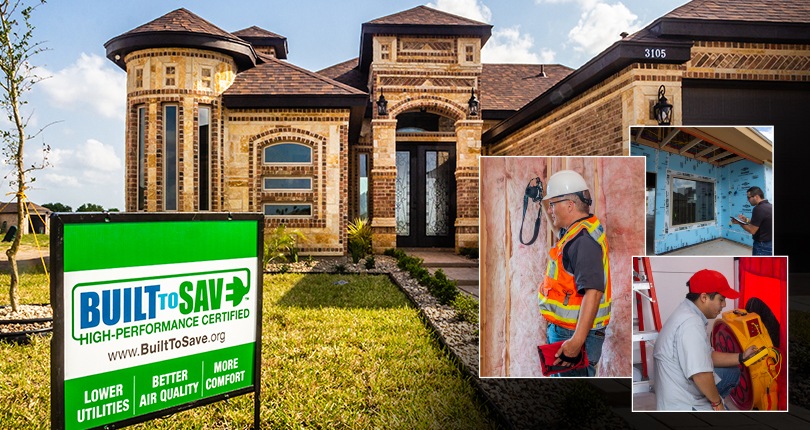
BUILT TO SAVE® Certification (RGV-Focused)
BUILT TO SAVE® is designed specifically for South Texas conditions, including the Rio Grande Valley.
Key characteristics:
- Focus on whole-home performance
- Third-party inspections and testing
- Verified insulation and air-sealing quality
- Emphasis on comfort, humidity control, and durability
- Performance beyond basic building code
BUILT TO SAVE® evaluates how all components of the home work together — not just individual features.
This climate-specific approach is critical in cooling-dominated regions like the RGV.
ENERGY STAR® Certified Homes
ENERGY STAR® is a national certification program administered by the U.S. Environmental Protection Agency.
ENERGY STAR certified homes:
- Are typically 10–20% more efficient than code
- Require third-party verification
- Must meet national performance criteria
While ENERGY STAR provides a strong baseline, it is not climate-specific. In South Texas, additional focus on humidity control and cooling performance is often needed beyond national minimums.
DOE Efficient New Homes (formerly Zero Energy Ready Home)
DOE Efficient New Homes is a U.S. Department of Energy program focused on high-performance construction.
These homes:
- Meet advanced efficiency standards
- Are designed to be solar-ready
- Often qualify for federal incentives, such as the 45L tax credit
Build on ENERGY STAR requirements
DOE Efficient New Homes are typically among the highest-performing homes but may not be necessary for every buyer or builder, depending on goals and budget.
What Is a HERS Score (And Why It Matters)?
Most certifications rely on a HERS score (Home Energy Rating System).
- A lower HERS score = better energy performance
- A typical new code-built home scores around 80–85
- Certified homes score significantly lower
HERS scores allow buyers to compare homes objectively — not subjectively.
In South Texas, a strong HERS score combined with verified construction quality is a powerful indicator of long-term performance.
Testing That Makes Certification Real
Certification isn’t paperwork – it’s testing.
Common tests include:
Blower Door Test
Measures how airtight the home is and identifies air leaks.
Duct Leakage Test
Confirms cooled air reaches living spaces efficiently instead of escaping into attics.
Insulation Inspection
Verifies insulation is installed correctly, not just present.
These tests ensure the home performs as designed – not assumed.
Which Certification Is Right for the Rio Grande Valley?
There is no one-size-fits-all answer. The right certification depends on:
Climate
Budget
Performance goals
Long-term ownership plans
For RGV buyers, programs that prioritize:
Cooling efficiency
Humidity control
Verified testing
Climate-specific standards
tend to deliver the best real-world results.
That’s why RGV-focused certifications matter.
Certification and Long-Term Savings
Certified energy-efficient homes often deliver:
Lower monthly energy bills
Improved comfort
Reduced HVAC wear
Better indoor air quality
Increased resale appeal
Over time, these benefits often outweigh modest upfront cost differences – especially in cooling-heavy climates.
How to Verify a Home’s Certification
Before buying, ask:
- Is the home certified?
- Which program?
- Was performance testing completed?
- Can I see documentation?
If the answers aren’t clear, the home may not be certified — regardless of how it’s marketed.
Frequently Asked Questions
Are energy-efficient home certifications required in Texas?
No. Certification is voluntary, which makes verified programs even more important for buyers.
Do certified homes cost more?
Sometimes slightly upfront, but lower operating costs often offset the difference.
Are certified homes better for resale?
Homes with documented performance and lower utility costs are increasingly attractive to buyers.
Final Takeaway: Certification Removes Guesswork
Energy-efficient home certification in Texas exists for one reason: to replace assumptions with verified performance.
In the Rio Grande Valley, where climate conditions amplify construction weaknesses, certification isn’t just a bonus — it’s protection.
If you want a home that performs better, feels more comfortable, and costs less to operate over time, certification matters.