
Energy-Efficient Home Certification in Texas: What It Means & How Built to Save® Works
South Texas homeowners pay some of the highest cooling bills in the country — and most new homes offer no documented proof they were built to reduce that cost. Energy-efficient home certification gives buyers a verified, third-party record showing their home meets real performance standards, not just marketing claims.
Built to Save® is the only regional certification program built specifically for the Rio Grande Valley climate. Magic Valley Electric Cooperative (MVEC) sponsors it, and independent RESNET-certified raters verify every home before certification is issued. This page covers what the certification requires, how the process works, and what both buyers and builders gain from it.
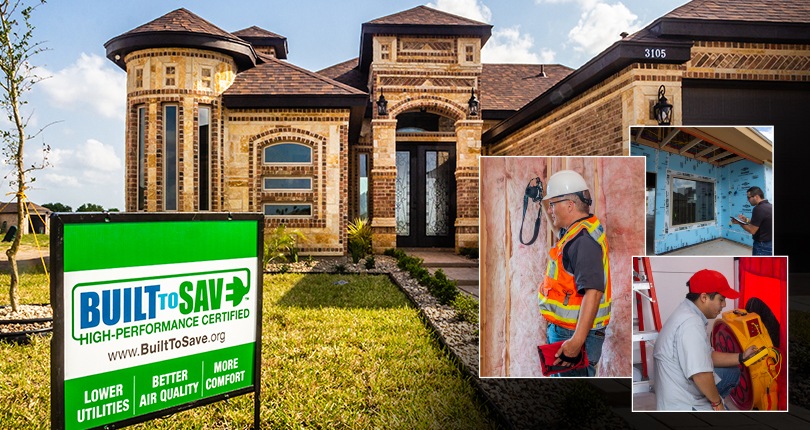
Why Texas Homes Need Climate-Specific Certification
Texas spans multiple climate zones, and performance requirements that work in Dallas fall short in McAllen. The Rio Grande Valley sits in ASHRAE Climate Zone 2 — among the hottest, most humid zones in the continental U.S. Temperatures regularly top 100°F, and air conditioners run for seven months or more each year.
A generic “energy-efficient” label does not account for that. Certification standards written for cooler climates use lower insulation thresholds, softer duct-leakage limits, and performance benchmarks calibrated to milder summers.
Built to Save® uses requirements written for this climate. A maximum HERS/ERI score of 63, construction at or above the 2015 International Energy Conservation Code, and on-site testing — not theoretical models — define the standard every certified home must meet.
What Is a HERS Score — and Why Does 63 Matter?
The Home Energy Rating System (HERS) is the national standard for measuring residential energy performance. A lower HERS score means a more efficient home. The scale sets a code-built home at 100.
A HERS score of 63 means the home uses roughly 37% less energy than a standard code-built home. Built to Save® sets that as the ceiling — or at least 5% better than current code, whichever is more stringent.
That threshold reflects what South Texas homeowners actually need to keep bills manageable through a long, hot season. For a full explanation of how HERS scores are calculated, read our guide: What Is a HERS Score?
The Built to Save® Certification Process
Built to Save® certification follows a structured sequence of steps. Builders cannot self-certify — every home requires two on-site inspections by an independent RESNET-certified rater. That structure exists because hidden construction defects are invisible by move-in day: gaps in the building envelope, poorly sealed ducts, and undersized insulation cannot be spotted with a walkthrough.
Step 1: Builder Registers with the Program
Builders enroll annually with Built to Save®. Registration confirms the builder understands current requirements and commits them to certifying at least one home per year to maintain active status. Builders who want to enroll can register here.
Step 2: Builder Selects a RESNET-Certified Home Energy Rater
The builder hires a RESNET-certified Home Energy Rater — a credentialed professional trained under the national RESNET standard to evaluate energy performance. The rater works independently of Built to Save® and MVEC. That separation is what makes the certification credible. Find a rater in South Texas.
Step 3: Pre-Drywall Inspection
Before drywall is installed, the rater visits the job site. This inspection checks:
- Insulation placement and coverage
- Air sealing at penetrations and framing gaps
- Duct routing through conditioned vs. unconditioned spaces
- Framing decisions that affect thermal bridging
Fixing a wall cavity problem at this stage costs a fraction of what it costs to repair it after the walls are closed.
Step 4: Construction Meets 2015 IECC + HERS Requirements
Throughout the build, the builder follows standards that meet or exceed the 2015 International Energy Conservation Code. The rater completes and submits compliance checklists documenting that the home meets every program requirement. The target: a final HERS/ERI score of 63 or lower.
Step 5: Final Inspection and Blower Door/Duct Testing
After construction, the rater returns for the final inspection. Two instrument-based tests confirm performance:
- Blower door test — measures air leakage through the building envelope
- Duct leakage test — confirms conditioned air reaches living areas rather than escaping into unconditioned spaces
Learn more about what blower door and duct testing involves.
Step 6: Certification Issued, Home Added to the Database
When the home passes both inspections and meets all requirements, Built to Save® issues the certification. The home is added to the program’s certified home database — a verifiable record buyers can reference at purchase and at resale.
What Homebuyers Get With a Certified Home
Lower Energy Bills
A Built to Save® certified home uses measurably less energy than a standard code-built home. In South Texas, where air conditioning can account for more than half of annual energy costs, that gap shows up on every monthly bill.
Independent Verification
The certification is not the builder’s claim — it is documented evidence from a credentialed third party. Two separate inspections, formal compliance checklists, and instrument-based testing back every certified home.
Comfort and Indoor Air Quality
Tight construction and well-sealed ducts do more than cut bills. They block humidity infiltration, eliminate hot spots near exterior walls and windows, and maintain consistent airflow throughout the home. In a climate where outdoor humidity can make a poorly built home feel uncomfortable even with the A/C running, that matters.
Resale Value
A certified home carries documentation a standard home does not. As energy costs rise and buyers research performance before signing, third-party certification carries real weight with future buyers and appraisers.
Ready to find a certified home in your area?
What Builders Get With Certification
Market Differentiation
Most RGV homes sell on square footage and finishes. A Built to Save® certified home gives builders a documented, third-party performance story that a competitor selling a standard home cannot match. That advantage grows as buyers increasingly research energy costs before committing.
A Structured Quality Process
The two-inspection requirement is not just a compliance step — it is a built-in quality checkpoint. Builders who use the program consistently report that catching construction problems at the pre-drywall stage cuts rework and callbacks on finished homes.
MVEC Partnership and Visibility
Built to Save® promotes certified builders across MVEC’s service territory. Certified builders appear in the program’s builder directory and marketing channels, reaching buyers who are actively comparing energy-efficient options.
Competitive Alignment with Federal Programs
Certified homes may align with or satisfy requirements for tax credits and incentive programs that reward third-party energy verification. For a side-by-side comparison, see: Built to Save® vs. ENERGY STAR® vs. DOE Zero Energy Ready Homes.
Builders: ready to register? Contact the Built to Save® team at 956-778-3590 or info@builttosave.org to get started.
Frequently Asked Questions
What is required to get a home certified in Texas through Built to Save®?
A home must achieve a HERS/ERI score of 63 or lower (or be at least 5% better than current energy code), meet or exceed 2015 IECC standards, pass both a pre-drywall inspection and a final inspection by a RESNET-certified rater, and have all compliance checklists completed and submitted. The builder must also hold active registration with the program.
How long does Built to Save® certification take?
The timeline follows the construction schedule. RESNET-certified raters conduct the pre-drywall inspection before walls close and the final inspection after construction ends. For most projects, certification runs alongside the build rather than adding time at the end. Builders who coordinate with their rater early in the project move through the process most efficiently.
Is Built to Save® certification available statewide in Texas?
Built to Save® is a regional program focused on the Rio Grande Valley and South Texas within MVEC’s service territory — not a statewide program. Builders and buyers outside that area can look to ENERGY STAR® for Homes or DOE Zero Energy Ready Homes, both of which operate nationally.
What is a RESNET-certified home energy rater?
A RESNET-certified Home Energy Rater is a professional trained and credentialed under the national Residential Energy Services Network standard. Raters conduct on-site inspections, perform blower door and duct leakage tests, and calculate HERS scores from verified measurements taken at the actual home. Their independence from the builder is what makes their findings credible. Find a certified rater near you.
Does Built to Save® certification expire?
The certification on a specific home does not expire — it is a permanent record tied to that home’s construction. Builder registration renews annually, and builders must certify at least one home per year to maintain active status. Homes certified under previous program cycles retain their certification.
Get Started with Built to Save®
For homebuyers: Find Built to Save® certified homes in South Texas and ask your builder about certification before you sign.
For builders: Learn how to get your homes Built to Save® certified or reach our team directly:
· Phone: 956-778-3590
· Email: info@builttosave.org